
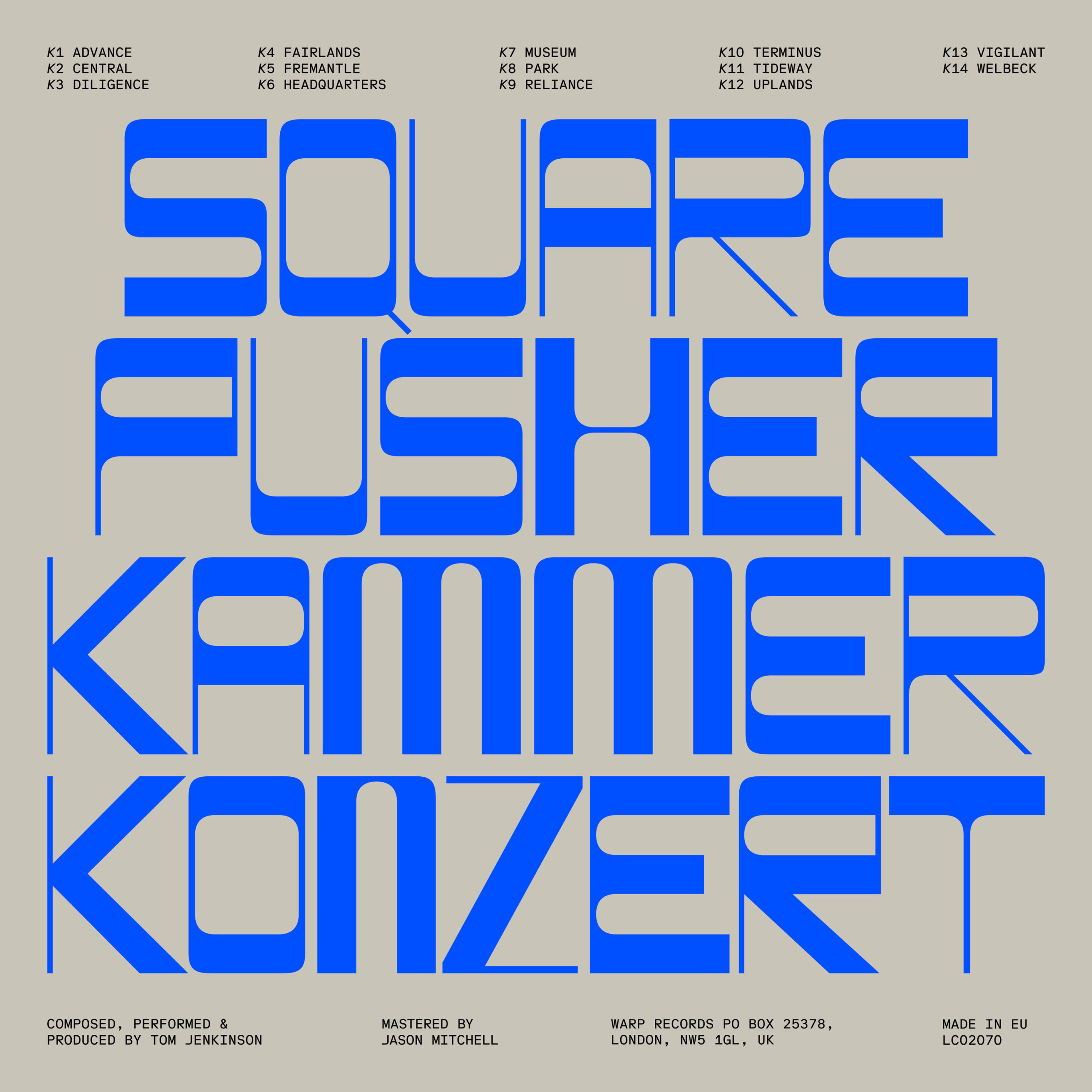
Kammerkonzert
—
Release on 10 April 2026
—
Warp Records
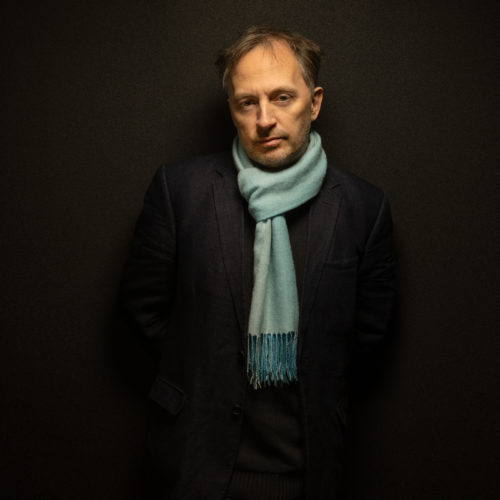
Tom Jenkinson, aka Squarepusher, a unique producer with roots in hardcore rave and electronic music, an experimental musician and architect of futuristic fusion forms, boasts a catalogue spanning three decades, studded with standout albums. From the furious acid breakbeat and devastating live bass attacks of Feed Me Weird Things (1996), to the literal proposition of Music For Robots (2014), via the raw virtuosity of Solo Electric Bass 1 (2009) and the luxurious, otherworldly concrete jazz of Ultravisitor (2004), few contemporary artists have explored such vast territory with such confidence.
And yet, despite this breadth, only two constants run through his work: unpredictability and the transgression of rules. His new album for Warp, due on 10 April, provides further proof of this. Conceived as a chamber concerto in which he performs all the parts himself, it stands in striking contrast to Port Rhombus EP, his first drum & bass EP for the label in 1996. With Squarepusher, the only truly predictable thing is his unpredictability. But this time, he seems to be taking it further: having exhausted the rules of others, he may now be beginning to deconstruct his own.
“Pitch is primary”: this was the maxim he set himself when he began working in earnest on Kammerkonzert, his sixteenth studio album. Following Music Is Rotted One Note (1998), a pivotal album blending musique concrète and future fusion, he claimed to have “abandoned” catchy melodies, deeming them too easy to win over listeners. From his home in Essex, he admits to having often broken this resolution, but points out that the priority given here to pitch does not constitute a return to SH-101-style monosynthetic anthems like ‘Journey To Reedham’. The tracks on Kammerkonzert are melodically rich, he says jokingly, “but I challenge anyone to hum them”.
Why would an artist forged in the crucible of hardcore rave choose to prioritise complex harmony at the expense of rhythm, texture or processing? “Because it’s an area that music technology struggles to capture, and that’s where the artist is most at risk of sounding bad. ”
On paper, the project might suggest a somewhat austere technical demonstration, a pretentious IDM exercise turning post-rave into post-pleasure. In reality, in the hands of Squarepusher, it is quite the opposite: a jubilant experience. Whilst the production was laborious for him, listening to it is a matter of marvelling at the discovery — as if one were suddenly stumbling upon a secret room filled with strange and fascinating objects, opening up a dizzying array of possibilities.
Kammerkonzert is brimming with riffs as hard as onyx and dazzlingly brilliant. The orchestral themes are formidable, the stylistic shifts abrupt, navigating between progressive, ambient, electronic and experimental. But above all, the album sparkles with a euphoric energy. Certain juxtapositions fleetingly evoke Magma (‘K1 Advance’), the fluid fusion of Weather Report’s …Body Electric era (‘K2 Central’), or even Ennio Morricone’s baroque and passionate soundtracks (‘K7 Museum’). Elsewhere, the contemporary jazz flourishes of Sons Of Kemet (‘K3 Diligence’), the modulated piano of Stockhausen’s ‘Mantra’, or the ambient atmosphere of Brian Eno with David Bowie (‘K11 Tideway’) come to the fore.
“A madman’s breakfast?” laughs Jenkinson. “That’s exactly the sort of music I love.” The remark takes on even greater significance given that these references seem systematically deconstructed. The influences appear, fragment, and vanish before one can even name them, often alongside other styles that emerge and transform simultaneously. Listening to it feels like standing too close to a hellish machine in perpetual flux — gears, pistons and microprocessors saturating the field of vision. Initially indecipherable, the whole gradually reveals its striking coherence.
Whilst several current figures in electronic music are exploring the“orchestral”, it would be reductive to equate Squarepusher with this movement. Where others rely on apparent sophistication, Kammerkonzert pushes inwards, to the very frontiers of composition. “The notions of maturity or sophistication that the word ‘orchestral’ might suggest do not interest me. ”
As for AI, he speaks of it with detachment. “Anyone can use technology that composes for them, but that’s outsourcing your talent and handing power over to a tech company. And AI is useless when it comes to capturing harmonic structures born of non-verbal intuition. ” For him, the real driving force remains the eureka moment, the leap into the unknown. “AI is militant mediocrity. ”
From the very first listen, one thing is clear: this is no traditional orchestra. Live drums, electric bass and guitar coexist with instruments drawn from a complex sound library, triggered via a MIDI guitar. Initially, Jenkinson wanted to work with classical musicians. He began composing for orchestra in 2016 and tested his scores with a chamber ensemble. But he came up against the limitations of traditional notation, which he felt was incapable of conveying the necessary rhythmic and textural nuance. “And besides, orchestras aren’t exactly renowned for their groove.”
He then began recording the parts himself, initially as a “deluxe demo”. Then circumstances forced him to continue on his own. During a stay on the Arctic archipelago of Træna, he slipped on the ice and fractured his wrist, fearing for a time that he would never be able to play bass again. Barely recovered, he lost a close friend, a shock he coped with by recording Be Up A Hello (2020). Then the pandemic put an end to any orchestral collaboration.
At a turning point, he realised that his “demos” had become the album itself. The work had evolved organically into something unprecedented: an orchestral album performed as a solo piece. A few electronic elements remain — a drum machine on ‘K2 Central’, breakbeats on ‘K4 Fairlands’, a ring modulator and complex reverb on ‘K11 Tideway’ — but they are like subtle touches on a vast canvas.
It is neither a traditional classical record nor an electronic album in the conventional sense. Rather, it is a standalone work, engaging in a subtle dialogue with Warp Works & 20th Century Masters (2006), on which the London Sinfonietta reinterpreted his compositions. Closer in spirit to All Night Chroma (2019), produced with James McVinnie, from which the final track ‘K14 Welbeck’ is taken.
Did he learn a new instrument for the occasion? “I wish I could say yes,” he smiles. He has, however, recently bought a second-hand viola and is learning fiddle tunes, hinting that the instrument might feature on future recordings. Now, with a finished album and precise scores in hand, he is looking more calmly towards a proper chamber orchestra performance — a new stage in a journey that is constantly evolving.
He concludes: “No idea should be off-limits in music. Combining breakbeats and a string quartet may seem risky, but avoiding the worst of both worlds is part of the job. Kammerkonzert is playful without being trivial, and fully embraces the risk.”