
Iggy Swaggering Ungrateful Incessant Little Peeeaaaaaaaa
—
Release on 27 February 2026
—

Radical, clever, complex: pop artist Kabeaushé’s performance is a big, joyful game. The singer, rapper, and producer creates a positively overwhelming and utterly captivating maelstrom of styles and references. From his hometown of Nairobi to his current home in Berlin. From French baroque music to soundtracks and rock to hip-hop and pop. All of this is jarring and yet, at the same time, makes sense when he lets a wide variety of influences from music, film, and painting escalate within his extravagant pop-cultural Gesamtkunstwerk. “It should bite a little in the ears,” says Kabeaushé, who is warm-hearted in conversation, and thoroughly angry on stage. Exploring the ideas of beauty, pain, and identity as far as possible, he is a hyper-creative powerhouse who expands boundaries as much as the title of his new third album, “Kabeaushe presents: Iggy Swaggering Ungrateful Incessant Little Peeeaaaaaaaa”.
Kabochi Gitau, his real name, created Kabeaushé to live out, explore, and savor his exciting art in all its facets. It’s a constant, dazzling process. And from this Kabeaushé universe, a character has emerged in recent years who now dominates the current album with terrifying splendor and sarcastic force: Mr. Iggy, head of the fictional empire The Doerf Kingdom. His people want to vote out this egomaniacal despot, but he desperately clings to power. In songs and videos, Kabeaushé tells the story of Iggy’s rise and fall.
With the overture “Pride Begets A Fall”, Kabeaushé sets the tone for this drama. Orchestra, marching sound, hymnal choir singing. Expectation and melancholy, epic atmosphere and gentle moments. A world-building in E minor. Just as Alfred Hitchcock did, setting the mood for the story at the beginning of classics such as “North by Northwest” or “Vertigo”. “The soul is then marinated,” says Kabeaushé, ready to let the story permeate all the senses. In “I Don’t Need You, So You Could Tell Me If I’m Gud”, Iggy rebels with megalomania against the resentment of his people. A funky monster with brass and bombast. Kabeaushé’s multi-layered vocals crash into the regal sounds of a spinet. High and exaggerated, interspersed with beatboxing and samples. A beguiling simultaneity. “I used my falsetto very aggressively for this album.” Another boundary-pushing move. The result is a restlessness that always carries within it the idea of catharsis.
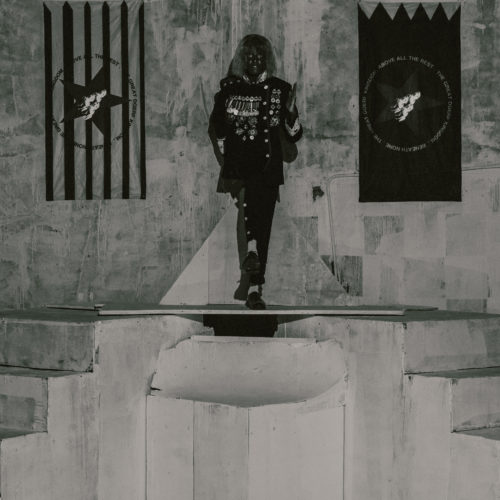
“I Don’t Need You, So You Could Tell Me If I’m Gud” is also the start of a series of videos that tells Iggy’s story in the intense style of black-and-white silent films. Kabeaushé is a huge movie fan and talks excitedly about how German cinema from the 1920s and 30s inspired him. Works such as “The Cabinet of Dr. Caligari” or “Dr. Mabuse, the Gambler”. “They created absolutely fascinating art on a small budget – from the fonts to the color scheme.” Kabeaushé adds his own unique twist to this aesthetic. His sets appear sharp-edged, imposing, and fragile at the same time. In front of the Doerf Kingdom flag, Iggy gives an exalted speech. He wears a fantasy uniform adorned with an absurd number of medals. His teeth are bared in a smile, his gestures expansive, his blond pageboy hair shining brightly. The handclaps in the song make it seem as if Iggy is applauding himself.
Is Kabeaushé using this character and the setting to comment on the current political situation? “Ultimately, we have all internalized experiences of power structures.” In the end, Kabeaushé tells a recurring story: glamour and grandeur, overconfidence and overload, decay and humility. He was deeply impressed by Stanley Kubrick’s opulent 1975 drama about the soldier “Barry Lyndon”. “The way he used classical music to first elevate and then destroy the character—I wanted to convey that feeling in my album as well.” And so Kabeaushé turned to Berlin-based composer Rui Rodrigues to translate that spirit into a highly contemporary pop version.
Kabeaushé is constantly thinking about how his music can be presented live, as a kind of theatrical production. In poses, dance, unshackling. “Physical performance is everything. But not too heavily choreographed. I also want to be able to surrender to the spontaneity of the moment.” Kabeaushé regularly tests new material in front of and with an audience. “Many decisions depend on how the music feels in concert and how the crowd reacts.” For example, the haunting drums in “We Have Ourselves A Shekdown”, which encourage the audience to march wildly. Disturbing sounds that intrude into the beat tell of how Iggy drifts into paranoia. An over-dramatization inspired by, among other things, Sergei Eisenstein’s monumental film “Ivan the Terrible”. “Life’s Waaaaay Too Fleeeeeteen”, on the other hand, is an ode to the chaos and volatility of life. Iggy dances in choppy movements into exhaustion. An energy that is transmitted immediately. According to the principle: overwhelm, breathe, overwhelm, breathe.
Kabeaushé’s art functions on both an intuitive and intellectual level. “Untitled 1981”, for example, is an homage to the blaxploitation films of the 1970s and Jean-Michel Basquiat’s series of paintings. The song itself, a mix of rap and deconstructed gospel, transfers directly to the body when you listen to it. “Clams Are Just Shells” combines the rough drive of a late 90s pop rock song with the rhythm of a 1950s twist. Always driven by Kabeaushé’s voice. Feverish, piercing, full of soul. This is how he develops his own unique, hyper-universal sound.
Kabeaushé is not a pretentious person who flaunts his cultural knowledge. Rather more of a geek, he eagerly dives into various rabbit holes and enjoys letting his art be fueled by the treasures he finds there. During his childhood and youth in Kenya, he was surrounded by a wide variety of music: country and gospel, Lingala and Benga, R&B and hip-hop. He has been producing rap and electro since 2015. In Kampala, he worked with the innovative Nyege Nyege collective and released his debut “The Coming Of Gaze” on their label Hakuna Kulala in 2023. That same year, his highly acclaimed album “Hold On To Deer Life, There’s A Black Boy Behind You!” was released by Monkeytown Records in Berlin. In 2024, Kabeaushé was awarded the Polyton Music Prize and the VIA VUT Award. His music has been featured in series such as “Queenie” and “How To Sell Drugs Online (Fast)”.
With his raw, glamorous shows, Kabeaushé has already performed across Europe and Africa, including Roskilde, Colors of Ostrava, and the Reeperbahn Festival, as well as Rock En Seine in Paris and The Great Escape in Brighton. During a collaboration with the Komische Oper Berlin, he began to take a greater interest in classical music. His new home is a constant source of inspiration. “I enjoy exploring the creativity in Berlin. Just look at all the museums and galleries. I can see a Nan Goldin retrospective and then go see a film poster exhibition,” Kabeaushé enthuses. His great game of stimulations, it continues to unfold. And yet it remains one thing above all else: deeply human.